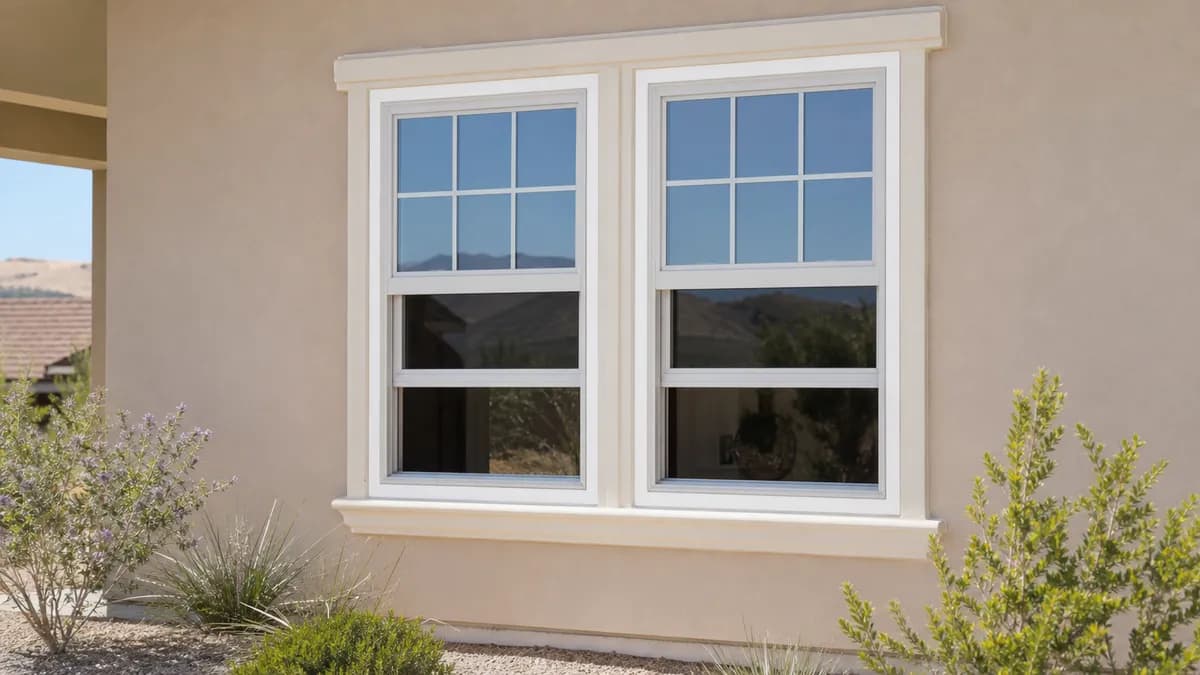
How double-hung and single-hung windows work
A double-hung window has two sashes, an upper and a lower, that slide up and down in a shared frame. Both can move, so you can open the bottom for low airflow or drop the top from above. Most modern units tilt inward for cleaning from inside, which matters on a second floor.
A single-hung window looks almost the same, but only the lower sash opens. The upper sash is fixed in the frame. That means fewer moving parts and a slightly lower price. National cost guides list single-hung at $250 to $700 per window (Fixr) and double-hung at $300 to $1,000 (Fixr), so the gap is real but modest.
Why they suit older Reno homes
Reno has a lot of 1970s to 1990s stucco ranches and two-story tract homes, many with original double-hung or slider openings. A double-hung replacement keeps the same look from the street and fits the same rough opening in most cases, which usually means an insert (retrofit) install. See retrofit vs full-frame windows for when each approach makes sense.
Where they fall short
Sashes slide in tracks, so a double-hung seals less tightly than a casement that compresses against a gasket. Over many Washoe Zephyr afternoons, dust and wind can find the meeting rail. Good weatherstripping and a modern balance system narrow the gap. If a tight seal and a full opening matter more than a traditional look, compare with casement windows.
Double-hung or single-hung: which to pick
| Factor | Single-hung | Double-hung |
|---|---|---|
| Operable sash | Bottom only | Top and bottom |
| Ventilation | Bottom opening only | Can open both, which lets warm air out the top |
| Cleaning | Exterior of the fixed top sash is reached from outside | Both sashes tilt in on most models |
| National price range (Fixr) | $250–$700 | $300–$1,000 |
| Best fit | Budget jobs, ground-floor windows, rarely opened rooms | Bedrooms, upper floors, rooms you vent often |
On a budget, single-hung on rarely opened windows and double-hung where you want ventilation and easy cleaning is a common split. An installer can price both on the same quote so you see the actual difference for your count of windows.
Frame and glass options for the high desert
Reno sits at about 4,505 feet. The July day-to-night swing averages 33.5°F (high 93.9°F, low 60.4°F), the airport sees about 122 days a year at or below freezing and about 65 days at or above 90°F, and annual precipitation is only 7.35 inches. Frames expand and contract through that range, and strong sun is hard on finishes, so frame material and glass package both matter.
Frame material
Vinyl windows are the usual double-hung choice because they are the lowest cost and need no painting. Fiberglass frames cost more and hold up well to temperature swings; see fiberglass windows. Wood is for matching a style or a historic look; see wood windows. The window frame materials guide compares all of them side by side.
Glass: U-factor and SHGC
NFRC rates windows on U-factor (how well the product keeps heat from escaping, lower is better) and SHGC (how much solar heat gets in, on a 0 to 1 scale). ENERGY STAR v7.0 lists the Reno/Washoe area in the Northern zone: U-factor 0.22 or lower with SHGC 0.17 or higher, or equivalent-performance options such as U 0.25 to 0.26 with SHGC at least 0.40. The City of Reno's EZ Permit sheet sets a minimum U-factor of 0.30 for window replacement. County-level zones near the Carson City and Douglas boundary were not confirmed, so ask the installer to check the label against your address.
Low-E coatings and argon gas fill are standard options on most double-pane units. Fixr lists Low-E glass at $300 to $1,100 per window. See double vs triple pane windows and energy efficient windows for what each upgrade is worth.
Double-hung window cost: national guide ranges
These are national cost-guide ranges, not Reno quotes. Local pricing depends on size, frame, glass package, install method and the installer.
| Item | National range | Source |
|---|---|---|
| Single-hung window, installed | $250–$700 | Fixr |
| Double-hung window, installed | $300–$1,000 | Fixr |
| Single-hung, installed | $100–$400 | HomeAdvisor |
| Double-hung, installed | $150–$650 | HomeAdvisor |
| Insert (retrofit) per window | $100–$400 | This Old House |
| Full-frame per window | $180–$1,500 | This Old House |
| Whole house, 10–15 windows, single story | $8,000–$12,000 | Fixr |
Guides disagree, which is normal: they survey different markets and define the job differently. A typical average across guides lands between $500 and $850 per installed window. For a Reno-specific breakdown of what moves the price, see window replacement cost in Reno.
Permits, safety glazing and wildfire rules
Permits
Unincorporated Washoe County exempts door and window replacement in the same opening and size when it meets applicable codes. The City of Reno's EZ Permit sheet lists window replacement with a U-0.30 minimum and window labels at inspection, so treat a Reno double-hung job as permit-required and have the installer confirm and pull it. Sparks and Carson City like-for-like rules are unconfirmed: confirm with the building department or the installer before work starts.
Safety glazing
Under the IRC hazardous-location rules, a window needs tempered or safety glass when the pane is over 9 sq ft, its bottom edge is under 18 inches from the floor, its top edge is over 36 inches, and a walking surface is within 36 inches. Glass within 24 inches of a door with its bottom edge under 60 inches also qualifies, as does glass near a tub or shower. A tall double-hung low to the floor in a stairwell or bath is the usual trigger. The City of Reno sheet lists these locations; the installer should check each opening.
Wildfire-area homes
Washoe County has adopted Chapter 5 of the 2024 International Wildland-Urban Interface Code. Its guide says exterior windows must be tempered glass, dual or triple-glazed insulating units, glass block, or carry a 20-minute fire-resistive rating. Replacement windows must keep the property's ignition-resistance level. Homes in foothill areas touched by recent fires, such as the Davis and Caughlin burn areas, should have the installer confirm the requirement with the fire district.
How to pick and what to ask the installer
- Count and size: measure each opening width, height and sill height, and note which ones are near doors, tubs or floors.
- Single or double-hung: decide room by room based on how often you open the window and whether you can reach the exterior.
- Frame: vinyl for cost, fiberglass for durability and slimmer sightlines, wood for matching existing trim.
- Glass: ask for the NFRC label showing U-factor and SHGC, and confirm it meets 0.30 or better for Reno.
- Install method: insert versus full-frame, and whether the quote includes trim, stucco repair and old-window disposal.
- Paperwork: license number, permit plan, and a written scope before you sign. Houses built before 1978 fall under EPA lead-safe rules for window replacement.
Reno Vista Windows does not sell or install windows. Request a match and we connect you with licensed installers who can measure, quote and handle the permit. For the full sequence, read the window replacement process.
Main guide: window replacement in Reno, NV.